
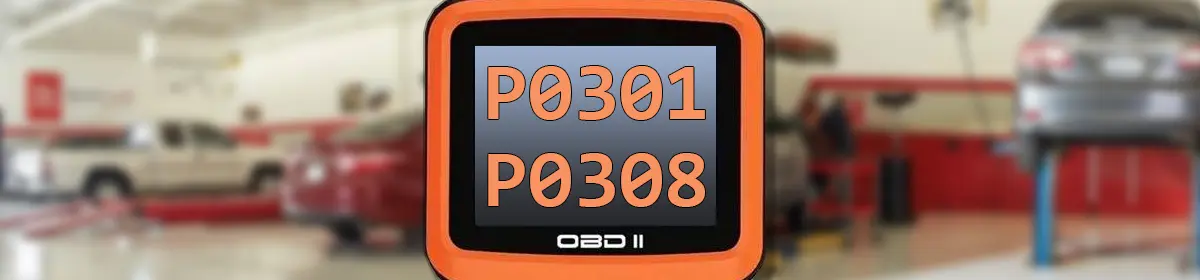
DTC P0301-P0308
Issue Description
The P0301-P0308 error codes indicate misfires in specific cylinders:
- P0301 Cylinder 1 Misfire Detected
- P0302 Cylinder 2 Misfire Detected
- P0303 Cylinder 3 Misfire Detected
- P0304 Cylinder 4 Misfire Detected
- P0305 Cylinder 5 Misfire Detected
- P0306 Cylinder 6 Misfire Detected
- P0307 Cylinder 7 Misfire Detected
- P0308 Cylinder 8 Misfire Detected
A misfire occurs when the air-fuel mixture in a cylinder fails to ignite properly, leading to inefficient combustion and engine operation.
Causes
Several factors can contribute to the P0301-P0308 error codes, including:
- Faulty Spark Plug: Worn, fouled, or damaged spark plugs can cause weak ignition.
- Defective Ignition Coil: A failing ignition coil can cause inconsistent or weak sparks.
- Fuel Injector Issues: A clogged or malfunctioning fuel injector can prevent proper fuel delivery.
- Vacuum Leaks: Leaks in the intake manifold or vacuum hoses can affect the air-fuel mixture.
- Low Fuel Pressure: A weak fuel pump or faulty fuel pressure regulator can cause lean misfires.
- Dirty or Failing Mass Airflow (MAF) Sensor: Incorrect airflow readings can disrupt combustion.
- EGR System Malfunction: A stuck or clogged Exhaust Gas Recirculation (EGR) valve can affect combustion.
- Crankshaft or Camshaft Position Sensor Issues: Faulty sensors can disrupt engine timing.
- Engine Mechanical Problems: Low compression due to worn piston rings, valves, or head gasket failure can cause misfires.
Symptoms
If your Toyota has a P0301-P0308 error code, you may notice the following symptoms:
- Check Engine Light (CEL) is On
- Rough Idling or Engine Vibration
- Reduced Power and Acceleration
- Increased Fuel Consumption
- Engine Hesitation or Stalling
- Unusual Exhaust Smell (Unburned Fuel)
Solutions to Fix the P0301-P0308 Code
- Inspect and Replace Spark Plugs
- Check for worn or fouled spark plugs.
- Replace with OEM-recommended spark plugs.
- Test and Replace the Ignition Coil
- Swap ignition coils between cylinders to identify a faulty coil.
- Replace defective ignition coils if needed.
- Check and Clean Fuel Injectors
- Use a fuel system cleaner to remove deposits from injectors.
- Replace clogged or faulty injectors if necessary.
- Inspect for Vacuum Leaks
- Listen for hissing sounds around the intake manifold.
- Use a smoke test to detect leaks.
- Replace cracked hoses or faulty gaskets.
- Check the Fuel System
- Test fuel pressure using a gauge to ensure proper delivery.
- Replace a weak fuel pump, clogged fuel filter, or faulty pressure regulator if needed.
- Clean the Mass Airflow (MAF) Sensor
- Remove and clean the MAF sensor with MAF-specific cleaner.
- Replace if faulty.
- Inspect the EGR Valve
- Check for carbon buildup in the EGR valve and passages.
- Clean or replace the valve if necessary.
- Test the Crankshaft and Camshaft Sensors
- Use an OBD-II scanner to check sensor readings.
- Replace faulty sensors if timing signals are inconsistent.
- Perform a Compression Test
- Test engine compression to check for mechanical issues.
- Address low compression by repairing valves, piston rings, or head gasket.
- Reset the ECM and Perform a Test Drive
- Use an OBD-II scanner to reset the ECM after repairs.
- Drive the vehicle and monitor for returning codes.


